
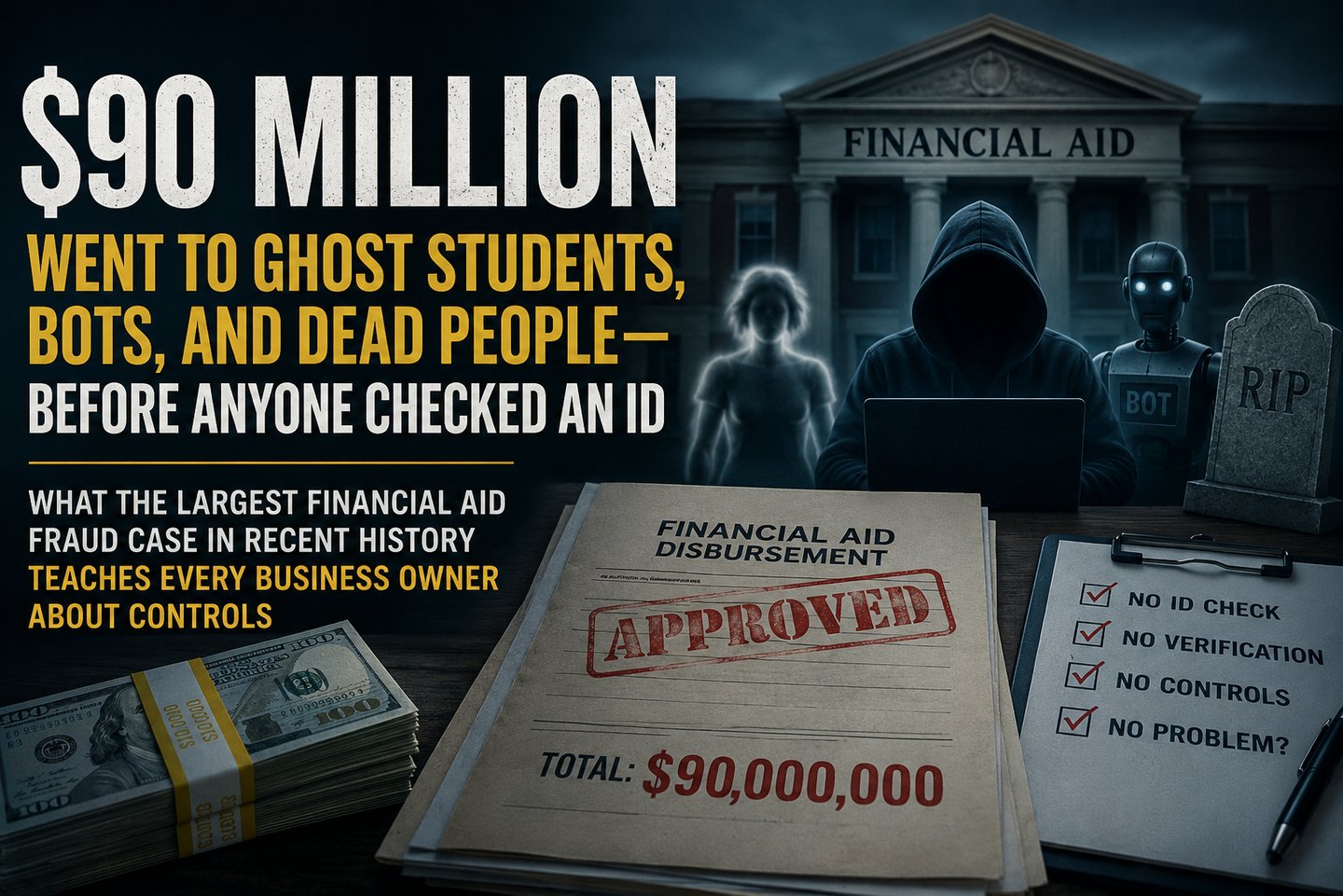
$90 Million Went to Ghost Students, Bots, and Dead People — Before Anyone Checked an ID
What the Largest Financial Aid Fraud Case in Recent History Teaches Every Business Owner About Controls
By Aurei Bookkeeping Innovators
6/24/20265 min read
For years, one of the largest financial systems in the country operated with almost no verification at all.
Less than 1% of applicants were ever asked to confirm their identity.
The result wasn't a small leak. It was a flood.
This is the story of how billions of taxpayer dollars moved through a system with no real financial controls — and what it teaches every business owner about protecting their own money.
The Discovery
The Free Application for Federal Student Aid — FAFSA — is the gateway to billions of dollars in grants and loans distributed to students across the United States every year.
For most of recent history, the identity verification requirement for first-time applicants covered less than 1% of submissions.
That gap did not go unnoticed. It got exploited — systematically, and at scale.
When the U.S. Department of Education finally conducted a comprehensive review, the findings were staggering:
Nearly $90 million in federal student aid disbursed to ineligible recipients.
Over $30 million sent to deceased individuals.
Over $40 million disbursed to companies operating fake student accounts using automated bots.
Thousands of "ghost students" — applicants who never attended a single class — collecting funds through real institutions.
In one state alone, 1,834 ghost students were identified collecting a combined $12.5 million in taxpayer-funded grants and loans. At a single community college, more than 100 fraudulent applications were submitted, on average, per academic year.
The pattern was consistent everywhere investigators looked: real money, flowing to applicants who didn't exist, weren't eligible, or were already deceased.
How the Fraud Actually Worked
Understanding how this happened matters more than the headline number — because the mechanics apply far beyond financial aid.
1. No identity verification at the point of entry. Anyone could submit an application. Almost no one was asked to prove who they actually were before funds were approved.
2. No real-time cross-checking against other government data. Applications were not being compared, in real time, against Social Security records. This allowed payments to continue flowing to deceased individuals long after they had passed away.
3. No systematic post-disbursement review. Once money went out, there was little to no process to review whether it had gone to a legitimate recipient. Fraud could continue undetected for years.
4. Automation outpaced oversight. As fraud rings became more sophisticated — using bots to generate fake applicants at scale — the system's manual, low-coverage verification process simply could not keep up.
This is not a story about one bad actor. It's a story about a system designed for trust, operating in an environment built for exploitation.
What Changed
Once the scale of the problem was identified, the response moved quickly:
Real-time identity verification was built directly into the application process — applicants showing risk indicators are now required to present government-issued ID before funds are released.
Data-sharing with the Social Security Administration was strengthened, immediately closing the gap that allowed payments to deceased individuals — saving more than $30 million on that issue alone.
A dedicated fraud detection team was established to investigate patterns and flag suspicious activity before money goes out the door, not after.
Legislation was introduced to make these verification requirements permanent, regardless of future administrations or policy priorities.
The total impact: over $1 billion in fraud prevented in a single aid cycle once real controls were finally put in place.
The lesson is not subtle: when verification is reintroduced, the fraud doesn't just slow down. It nearly disappears.
The 4 Lessons Every Business Owner Needs From This
You don't manage a multi-billion dollar federal program. But the financial control failures that allowed this fraud to happen exist — in smaller form — in businesses every single day.
Lesson 1: "Trust" Is Not a Financial Control
The FAFSA system operated for years on the assumption that applicants were telling the truth. That assumption cost taxpayers tens of millions of dollars.
In your business:
Do you verify invoices before paying them, or do you trust that every bill received is legitimate?
Do you reconcile your bank statements every month, or do you trust that your books already reflect reality?
Do you review who has access to your business bank accounts and payment systems?
Trust is not a control. Verification is. The businesses that lose the least money to fraud and error are the ones that verify — every month, without exception.
Lesson 2: If Nobody Is Checking, Something Is Probably Wrong
Less than 1% of FAFSA applicants were verified. The fraud that emerged wasn't a coincidence — it was a predictable result of near-zero oversight.
In your business:
If no one reconciles your accounts monthly, errors and discrepancies can run for months — or years — completely undetected.
If no one reviews vendor payments against actual signed contracts or invoices, overbilling or duplicate payments can slip through indefinitely.
If your books are more than 30 days behind, you have no real-time way to catch a problem while it's still small.
The absence of a control is not neutral. It is an invitation.
Lesson 3: Fraud and Errors Compound the Longer They Go Undetected
Some of the deceased individuals in the FAFSA system had been receiving funds for an extended period before the Social Security data-sharing fix caught the issue. The longer the gap existed, the more money flowed through it.
In your business: The same is true of:
A duplicate transaction that goes unreconciled for six months.
A subscription that auto-renewed and was never reviewed.
A bookkeeping error that compounds every month it isn't corrected.
Monthly bank reconciliation exists for exactly this reason — to catch problems while they are still small enough to fix in minutes, not large enough to require a forensic review.
Lesson 4: The Fix Is Rarely Complicated — It's Just Often Skipped
The solution to the FAFSA fraud crisis wasn't a complex new technology. It was identity verification — something nearly every other financial transaction in modern life already requires.
In your business: The fixes that prevent the most common forms of financial loss are not exotic either:
Monthly bank and credit card reconciliation.
A documented approval process before any payment goes out.
Separation of duties — the person who approves an expense should not be the same person who pays it, whenever possible.
Monthly review of your Profit & Loss and Balance Sheet to catch anything that looks unusual.
These are not advanced financial strategies. They are basic financial hygiene — and they are the difference between catching a problem in 30 days or discovering it after $90 million has already gone out the door.
What This Means If You're a Small Business Owner
It's tempting to read a story like this and think it doesn't apply to you. Your business isn't processing billions of dollars. You know your team. You trust your processes.
But the FAFSA case is not really about scale. It's about what happens in any system — large or small — when financial verification is treated as optional rather than essential.
A small business without monthly reconciliation, without a clear chart of accounts, and without regular financial reviews is operating on the same kind of trust-based assumption that allowed $90 million to walk out the door of a federal program.
The good news: fixing it at the scale of a small business is far simpler than fixing it at the scale of the federal government.
It starts with one decision: treating your monthly bookkeeping as a financial control — not just a tax-season formality.
Build the Financial Controls Your Business Deserves
At Aurei Bookkeeping Innovators, we help small business owners build the financial systems that catch problems early — monthly reconciliation, organized records, and clear reports that show you exactly where your money is going, every single month.
Not once a year. Not when something already feels wrong.
Every month — so small issues stay small.
Schedule your free consultation today.
📞 (305) 306-3981
📲 @AureiBooks
Clarity. Strategy. Financial Confidence.
© 2026 Aurei Bookkeeping Innovators LLC. All rights reserved. This article is intended for educational purposes and does not constitute financial, legal, or tax advice. It is based on publicly reported information regarding federal student aid program fraud prevention efforts.
Explore
AureiBooks@gmail.com
© 2026. All rights reserved.


AureiBooks
Strategic bookkeeping and advisory for South Florida small businesses and real estate professionals.
HABLAMOS ESPAÑOL · PROUDLY SERVING MIAMI & SOUTH FLORIDA
Connect:
Email:
Phone:
(305) 306-3981
Address:
20200 W Dixie Hwy, Suite 902
Aventura, FL 33180, United States